Sara’s mental-health crisis
Dark Lies the IslandSara’s mental-health crisis is marked by a dangerous conflict between urges to harm herself and efforts to resist them. The narrative places her alone in a holiday home, where sleeplessness, self-harm scars, slow internet access, and recurring visions of faces at the windows converge. Her experiences remain unresolved: the text neither reduces them to a single diagnosis nor confirms that the apparent visitors are real. The episode culminates in a concrete act of removing all nine kitchen knives from reach, followed by a brief interval of calm beside Clew Bay.
Background and Signs of Distress
Sara has completed her Leaving Certificate, with results arriving in August and enough points for Medicine or Veterinary studies. Academic possibilities coexist with months of poor sleep and scars on her wrists, thighs, and ankle, including the remains of a smiley she carved into her skin. The contrast between her many available paths and the persistence of distress is part of the crisis’s presentation; achievement does not resolve what she is experiencing.
At the holiday home, the lack of ordinary internet access frustrates her. She relies on dial-up and visits the cineplex to use its coin-operated terminals, where she accesses 4-Real Forum. One evening she types that she may cut herself. The screen-based exchange becomes part of a scene in which the possibility of self-harm is immediate, while the slow connection and isolation leave her alone with it.
The House and the Faces
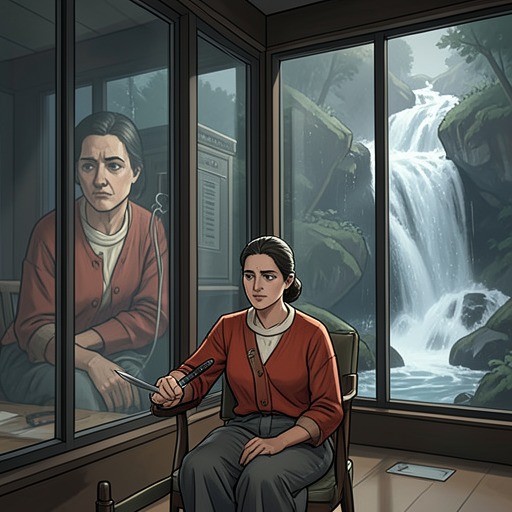
Sara repeatedly switches off the lamps and sits near the stream, hoping darkness will banish what she sees beyond the glass. Instead, faces appear at the windows: sometimes an open mouth, sometimes a fleeting profile. The stream’s murmur seems to her like voices from outside. Her response is divided—she believes what she perceives and doubts it at once—so the narrative preserves uncertainty rather than explaining the faces as either supernatural visitors or a confirmed symptom.
The sense of threat intensifies when she steps outside and experiences hands gripping her neck and restricting her breath. She escapes indoors and sees faces crowding the window before they disappear. The scene gives the crisis a physical force in Sara’s experience, but does not establish an external assailant. Later, the text explicitly notes that her father’s explanation of internet addiction does not account for the throat-gripping sensation, the menacing door handles, the faces, or the medication. This leaves the causes of her experiences unsettled.
The Crisis at Its Peak
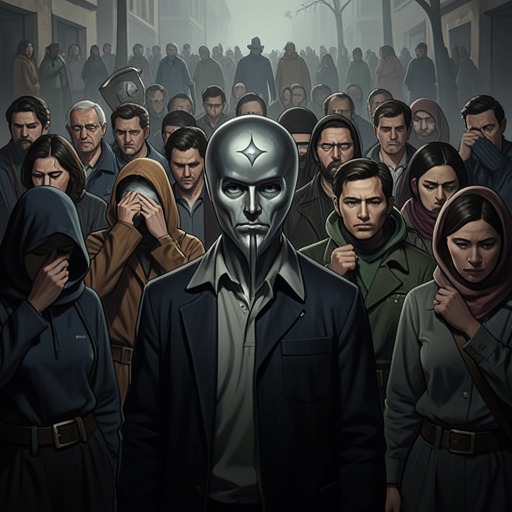
The episode returns repeatedly to the possibility of cutting, placing self-harm within a cycle of anticipation, online contact, and attempts at restraint. Sara’s forum message, “Maybe tonite …”, is followed by the terse instruction “Don’t cut, his eyes said.” Later, alone in the holiday home, she considers cutting her thigh and experiences the urge as a fatal certainty: the voice she attributes to the Dark Angel tells her that the situation will not improve and will last forever. The crisis is therefore not presented as a single impulse that passes, but as pressure that recurs and speaks in the language of permanence.
Music briefly interrupts that momentum. When the television unexpectedly plays “For No One,” Sara stops moving and listens through the song, taking it as a message. Yet she then turns the television off, and the danger remains. The scene makes the interruption meaningful without making it a cure: a song can arrest her attention, but it does not settle what she should do next.
As the rain eases, Sara goes to the Sabatier block and removes all nine knives from the set. She carries them outside and throws them, one after another, into the dark, boggy ground, unable to see where they land but sensing that they have been taken. This decisive action changes the immediate circumstances of the crisis: the knives are no longer within the holiday home. It does not erase the thoughts that brought her to them, but it converts the episode from an approach toward self-injury into an effort to put the means beyond reach.
Aftermath and Narrative Significance
Having put the knives beyond reach, Sara wraps herself in her father’s duffel coat and walks barefoot to a high vantage overlooking Clew Bay, its small islands, and the Atlantic. A break in the clouds briefly illuminates one low island; she sits on the wet ground, draws her knees close, and allows the outside world to recede. The reprieve is modest but perceptible: for a short while, she experiences something like sleep. The episode ends not with an explanation or cure, but with a practical act that reduces immediate access to the knives and a temporary interval of quiet.
The narration sustains uncertainty around the faces, the apparent assault, and the sources of Sara’s distress. It records both her conviction and her doubt, while explicitly distinguishing her father’s account of internet addiction from the experiences that account cannot explain. That unresolved tension matters: the crisis is rendered through Sara’s frightening perceptions and concrete choices without confirming a supernatural cause or supplying a definitive diagnosis. The movement from the enclosed, darkened holiday home to the exposed view across the bay offers no promised recovery, only a pause in which she can sit, withdraw from the urge, and briefly rest.
Aftermath and Narrative Significance
Having put the knives beyond reach, Sara wraps herself in her father’s mustard-colored duffel coat and walks barefoot to a high vantage overlooking Clew Bay, its small islands, and the Atlantic. A break in the clouds briefly illuminates one low island; she sits on the wet ground, draws her knees close, and allows the outside world to recede. The reprieve is modest but perceptible: for a short while, she experiences something like sleep. The episode ends not with an explanation or cure, but with a practical act that reduces immediate access to the knives and a temporary interval of quiet.
The narration sustains uncertainty around the faces, the apparent assault, and the sources of Sara’s distress. It records both her conviction and her doubt, while explicitly distinguishing her father’s account of internet addiction from the experiences that account cannot explain. That unresolved tension matters: the crisis is rendered through Sara’s frightening perceptions and concrete choices without confirming a supernatural cause or supplying a definitive diagnosis. The movement from the enclosed, darkened holiday home to the exposed view across the bay offers no promised recovery, only a pause in which she can sit, withdraw from the urge, and briefly rest.